La designazione di un cuscinetto radiale a sfere combina una serie dimensionale e un numero di foro, così che un codice come 6204 o 608 fissa in modo univoco diametro interno, diametro esterno e larghezza. L’articolo descrive le cinque serie principali, la lettura del numero di foro, il catalogo di 65 designazioni basato sulla norma JIS e la ricerca inversa a partire dalle dimensioni misurate, sempre legati al generatore di cuscinetti di meta-matic.
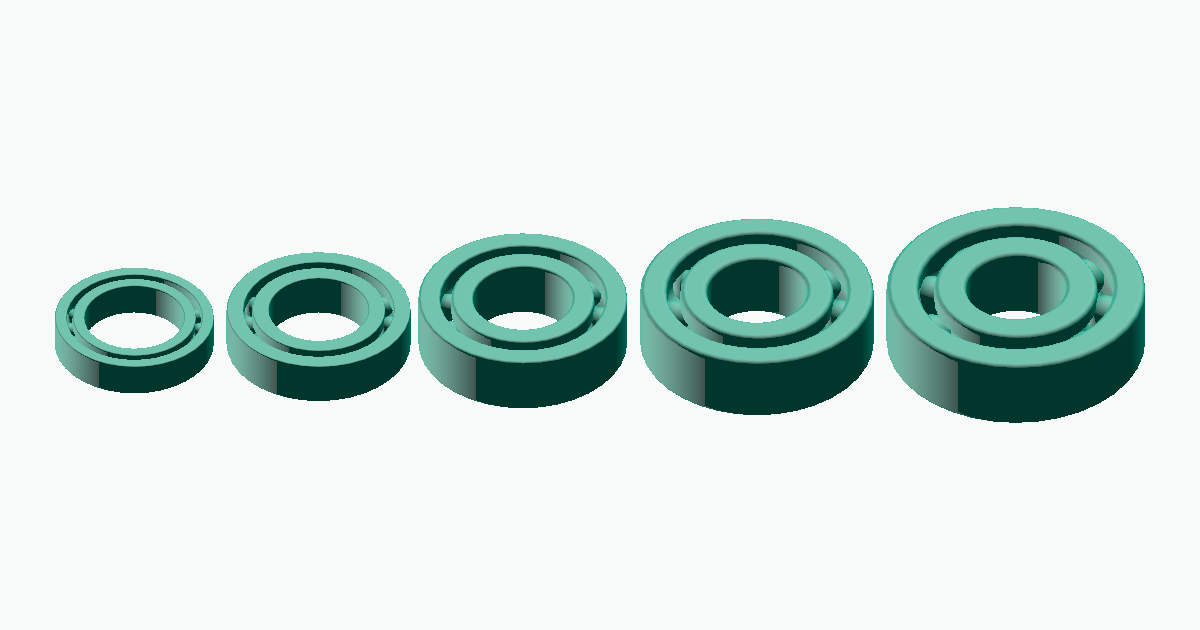
Designazioni dei cuscinetti spiegate — 6204, 608 e il catalogo di 65 tipi
The designation of a deep groove ball bearing — written as 6204 or 608 in three or four digits — is a standardized identification number for its dimensions. As in the "62" of 6204 or the "68" of 6804, the leading size series encodes the cross-sectional dimensions (the balance of outer diameter and width), and the trailing bore number encodes the inner diameter d. This guide explains how to choose among the five major series (68 / 69 / 60 / 62 / 63), how to read the bore number, the bearing size chart of 65 designations drawn from JIS B 1521 / ISO 15, and how to identify a bearing from measured dimensions — all tied to the bearing generator on meta-matic.
What is a bearing designation?
A designation such as 6204 identifies the standardized boundary dimensions of a bearing — bore 20 mm, outer diameter 47 mm, width 14 mm, and minimum chamfer dimension r ≤ 1.0 mm — so any ISO/JIS-compliant bearing with the same designation, regardless of manufacturer, shares the same standardized dimensions. This is the same mechanism by which screw sizes like M3 or M5 uniquely fix the diameter and pitch: the standard guarantees interchangeability. Sealing (ZZ/2RS), internal clearance codes (C2/C3), and precision class codes (P5/P4) are specified separately as suffixes.
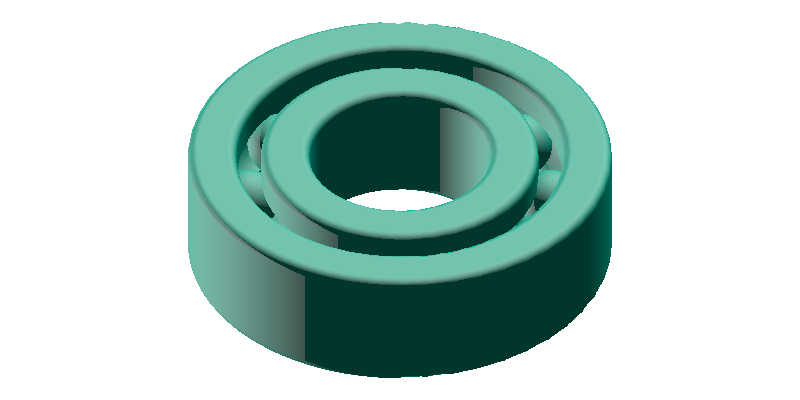
Deep groove ball bearing designations follow the standard boundary dimensions defined by JIS B 1521 / ISO 15. Because the four values d / D / B / r are uniquely determined from the designation, writing "use 6204" on a drawing fixes the shaft diameter, housing bore, spacer thickness, and so on. The reverse trap: if you try to choose "a bearing about the same size" without knowing the designation, you can end up with the same d but a different outer diameter or width that no longer fits the existing housing.
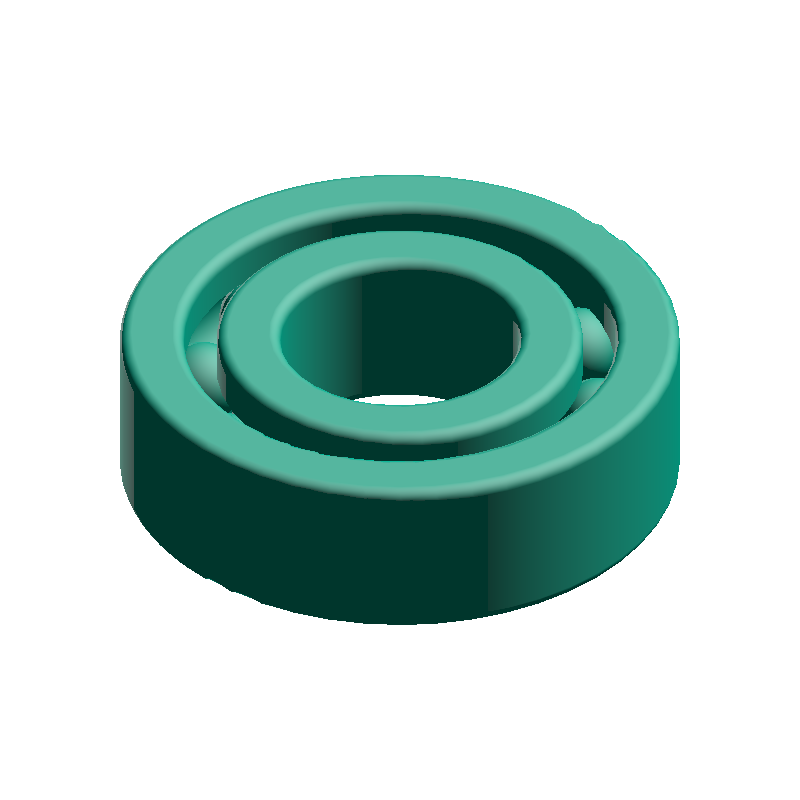
ZZ, the contact-sealed suffix 2RS, other bearing forms such as tapered roller bearings or thrust bearings, internal-clearance codes C2/C3/C4, and precision class codes are out of scope.The two parts of a designation
A designation has two parts: the size series and the bore number. In 6204, 62 is the size series (62 series = medium load) and 04 is the bore number (inner diameter d = 04 × 5 = 20 mm). Within the same series the outer diameter and width change as the bore number changes; with the same bore, the outer diameter and width change as the series changes.
- Size series (leading 2 digits) — five options:
68/69/60/62/63. Higher numbers mean larger outer diameter and thicker rings, which raise the load capacity - Bore number (trailing 2 digits) — values from
00to10. For04and above, the number × 5 = inner diameter d (mm) (see § Reading the bore number for details) - Miniature family (
688/608and other 3-digit designations) — the trailing single digit directly gives the bore (e.g.,688is bored=8 mm, series68)
Once you internalize this structure, you can read relationships such as "6204 and 6304 share the same bore 20 mm but differ in series" or "6004 and 6204 differ in series but both have bore 20 mm" directly from the designation alone.
The five major series compared
Deep groove ball bearing series are organized into five steps from thin-section to heavy-duty. Lining the five series up at the same inner diameter d = 20 mm (bore number 04) shows the outer diameter and width growing in steps.
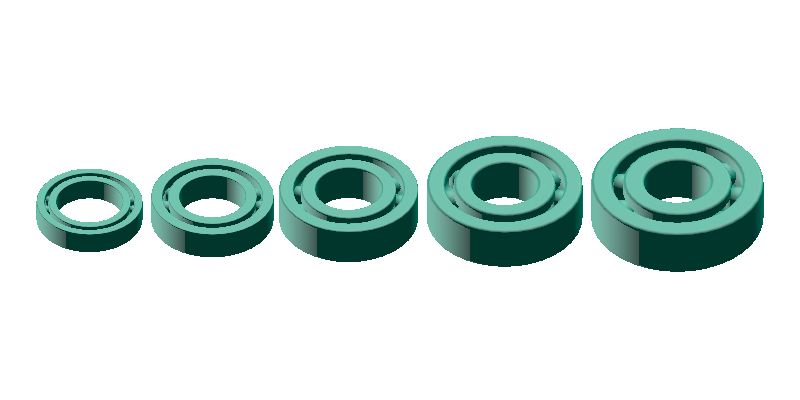
| Series | Common name | Example at d=20 | Outer D / Width B | Typical use |
|---|---|---|---|---|
| 68 series | Extra-thin | 6804 | 32 / 7 mm | Small robots, camera gimbals, low-profile mechanisms |
| 69 series | Thin | 6904 | 37 / 9 mm | Compact reducers, bicycle hubs, 3D printer moving parts |
| 60 series | Light load | 6004 | 42 / 12 mm | Small motors, desktop equipment, the DIY default |
| 62 series | Medium load | 6204 | 47 / 14 mm | Most common. Power tools, DC motors, general-purpose machinery |
| 63 series | Heavy load | 6304 | 52 / 15 mm | Industrial machinery, high-torque reducers, heavy-load shafts |
62 series is often the first choice. Compared with the 60 series at the same bore, the 62 series (6200〜6210) has a larger outer diameter and width, which raises the load capacity. Availability is also good. Move on to the 68 / 69 series only when you actually need to make things thinner or lighter — that order leads to the fewest design backtracks.Reading the bore number
The mapping from bore number (the trailing two digits of a designation) to the actual inner diameter d is a discontinuous lookup table. The values 00 to 03 are irregular, and from 04 onward you can compute the bore mechanically with number × 5 mm.
| Bore number | Inner diameter d (mm) | Formula | Example designations |
|---|---|---|---|
| 00 | 10 | (irregular) | 6000 / 6200 / 6800 |
| 01 | 12 | (irregular) | 6001 / 6201 / 6801 |
| 02 | 15 | (irregular) | 6002 / 6202 / 6802 |
| 03 | 17 | (irregular) | 6003 / 6203 / 6803 |
| 04 | 20 | 04 × 5 = 20 | 6004 / 6204 / 6804 |
| 05 | 25 | 05 × 5 = 25 | 6005 / 6205 / 6805 |
| 06 | 30 | 06 × 5 = 30 | 6006 / 6206 / 6806 |
| 07 | 35 | 07 × 5 = 35 | 6007 / 6207 / 6807 |
| 08 | 40 | 08 × 5 = 40 | 6008 / 6208 / 6808 |
| 09 | 45 | 09 × 5 = 45 | 6009 / 6209 / 6809 |
| 10 | 50 | 10 × 5 = 50 | 6010 / 6210 / 6810 |
00〜03 (10 / 12 / 15 / 17) has no pattern and is the most error-prone part during design. A classic mistake is reading "6200 so the bore is 20 mm" — in fact 6200 has a 10 mm bore (you only reach a 20 mm bore at 6204). From 04 upward you can just multiply by 5, so no memorization is needed.The miniature family (688 / 698 / 608 / 628 / 638 and so on) puts the bore in the trailing single digit. 688 reads as 68 series, bore 8 mm; 609 reads as 60 series, bore 9 mm. These are dedicated extra-small sizes — the generator currently includes ten miniature variants across the d8 and d9 lineups.
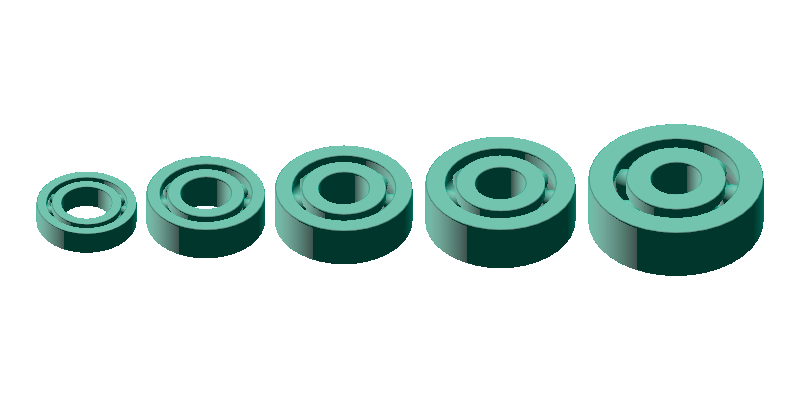
Bearing Size Chart (65 Designations)
The following bearing size chart lists the 65 designations that meta-matic can generate, organized by series. The four values d / D / B / r follow the JIS B 1521 / ISO 15 standard boundary dimensions as a reference.
68 series (extra-thin, 11 designations)
| Designation | d | D | B | r |
|---|---|---|---|---|
6800 | 10 | 19 | 5 | 0.3 |
6801 | 12 | 21 | 5 | 0.3 |
6802 | 15 | 24 | 5 | 0.3 |
6803 | 17 | 26 | 5 | 0.3 |
6804 | 20 | 32 | 7 | 0.3 |
6805 | 25 | 37 | 7 | 0.3 |
6806 | 30 | 42 | 7 | 0.3 |
6807 | 35 | 47 | 7 | 0.3 |
6808 | 40 | 52 | 7 | 0.3 |
6809 | 45 | 58 | 7 | 0.3 |
6810 | 50 | 65 | 7 | 0.3 |
69 series (thin, 11 designations)
| Designation | d | D | B | r |
|---|---|---|---|---|
6900 | 10 | 22 | 6 | 0.3 |
6901 | 12 | 24 | 6 | 0.3 |
6902 | 15 | 28 | 7 | 0.3 |
6903 | 17 | 30 | 7 | 0.3 |
6904 | 20 | 37 | 9 | 0.3 |
6905 | 25 | 42 | 9 | 0.3 |
6906 | 30 | 47 | 9 | 0.3 |
6907 | 35 | 55 | 10 | 0.6 |
6908 | 40 | 62 | 12 | 0.6 |
6909 | 45 | 68 | 12 | 0.6 |
6910 | 50 | 72 | 12 | 0.6 |
60 series (light load, 11 designations)
| Designation | d | D | B | r |
|---|---|---|---|---|
6000 | 10 | 26 | 8 | 0.3 |
6001 | 12 | 28 | 8 | 0.3 |
6002 | 15 | 32 | 9 | 0.3 |
6003 | 17 | 35 | 10 | 0.3 |
6004 | 20 | 42 | 12 | 0.6 |
6005 | 25 | 47 | 12 | 0.6 |
6006 | 30 | 55 | 13 | 1.0 |
6007 | 35 | 62 | 14 | 1.0 |
6008 | 40 | 68 | 15 | 1.0 |
6009 | 45 | 75 | 16 | 1.0 |
6010 | 50 | 80 | 16 | 1.0 |
62 series (medium load, 11 designations, most common)
| Designation | d | D | B | r |
|---|---|---|---|---|
6200 | 10 | 30 | 9 | 0.6 |
6201 | 12 | 32 | 10 | 0.6 |
6202 | 15 | 35 | 11 | 0.6 |
6203 | 17 | 40 | 12 | 0.6 |
6204 | 20 | 47 | 14 | 1.0 |
6205 | 25 | 52 | 15 | 1.0 |
6206 | 30 | 62 | 16 | 1.0 |
6207 | 35 | 72 | 17 | 1.1 |
6208 | 40 | 80 | 18 | 1.1 |
6209 | 45 | 85 | 19 | 1.1 |
6210 | 50 | 90 | 20 | 1.1 |
63 series (heavy load, 11 designations)
| Designation | d | D | B | r |
|---|---|---|---|---|
6300 | 10 | 35 | 11 | 0.6 |
6301 | 12 | 37 | 12 | 1.0 |
6302 | 15 | 42 | 13 | 1.0 |
6303 | 17 | 47 | 14 | 1.0 |
6304 | 20 | 52 | 15 | 1.1 |
6305 | 25 | 62 | 17 | 1.1 |
6306 | 30 | 72 | 19 | 1.1 |
6307 | 35 | 80 | 21 | 1.5 |
6308 | 40 | 90 | 23 | 1.5 |
6309 | 45 | 100 | 25 | 1.5 |
6310 | 50 | 110 | 27 | 2.0 |
Miniature family d=8 / d=9 (10 designations)
| Designation | d | D | B | r | Note |
|---|---|---|---|---|---|
688 | 8 | 16 | 4 | 0.2 | 68 series |
698 | 8 | 19 | 6 | 0.3 | 69 series |
608 | 8 | 22 | 7 | 0.3 | 60 series, skateboard standard |
628 | 8 | 24 | 8 | 0.3 | 62 series |
638 | 8 | 28 | 9 | 0.3 | 63 series |
689 | 9 | 17 | 4 | 0.2 | 68 series |
699 | 9 | 20 | 6 | 0.3 | 69 series |
609 | 9 | 24 | 7 | 0.3 | 60 series |
629 | 9 | 26 | 8 | 0.6 | 62 series (r=0.6 is non-JIS) |
639 | 9 | 30 | 10 | 0.6 | 63 series |
Identify a bearing from measured dimensions
For repairs of secondhand machinery or existing equipment, "the bearing in my hand has no readable designation" is a common situation. With a caliper or micrometer you can measure d / D / B and look up the designation in the bearing size chart above. The corner radius r is hard to measure, but if d / D / B do not overlap any other row you can usually narrow down to a single row at that point.
Measure the inner diameter d
Measure the bore diameter with a caliper. This is the dimension with the best measurement accuracy, so anchoring the search todis the most reliable starting point.Measure the outer diameter D
Measure the outer ring outer diameter. Combined withd, the series is largely fixed, so measuringDwill for a typical deep groove ball bearing usually narrow the result to one of the 68/69/60/62/63 series (the 16000 series, R series, and other specialty parts require separate confirmation).Measure the width B
Measure the axial thickness with a caliper. Two bearings with the samed / Dbut a differentBare different designations (e.g.,6004and6204shared=20but haveB=12vs14).Cross-check against the chart
Look up these three values in the § Bearing Size Chart and read the matching designation. Ifr(corner radius) also matches, you are likely looking at a standard series part. If it does not match, it may be a manufacturer-specific size or follow a different standard (ISO / DIN, etc.).
d / D / B / r automatically shows the matching designation in the REF card. If the dimensions match a JIS standard the designation appears; otherwise it shows CUSTOM. It can be used to identify the part number of an existing bearing whose designation is unreadable.Generate STEP data
Once you have the designation or the four values d / D / B / r, meta-matic can generate a STEP file for 3D CAD on the spot. Type a designation like 6204 into the designation field on the form and the four dimensions auto-fill. The output loads into major CAD packages such as Fusion 360, FreeCAD, SolidWorks, and Rhinoceros.
ZZ), contact seals (2RS), the cage, and grease are not included. The output is suitable as a reference shape for drawings or as a placeholder for 3D printing, but if you need true-to-life seal structure, add those parts in your CAD software. The internal groove radius, ball count, and ball diameter are not defined by JIS, so they are generated by an in-house geometric rule (a reference implementation, not full standard conformance).Also, when mounting a bearing on a shaft, the fit tolerance between the shaft and the bearing inner diameter matters. The bore of a 6204 is nominally 20 mm, but the actual tolerance is on the order of +0 / -0.010 mm depending on the precision class. Whether you make the shaft side a "clearance fit", "transition fit", or "interference fit" depends on the rotation direction, load conditions, and temperature variation. For concrete shaft diameters and tolerance classes, see the ISO fit tolerance calculator.
Frequently asked questions
QWhat is the difference between `6204` and `608`?
6204 is 62 series, bore 20 mm (outer 47mm / width 14mm), while 608 is 60 series, miniature family, bore 8 mm (outer 22mm / width 7mm). 6204 is widely used in power tools and motor shafts; 608 shows up in 3D printer extruders and skateboards.QShould I use the `6000 series` or the `6200 series`?
QWhat do the `ZZ` and `2RS` in `6204ZZ` or `608-2RS` mean?
ZZ (or 2Z) indicates two metal shields for a dust-resistant type; 2RS (or 2RU) indicates two contact rubber seals for water- and dust-resistant types. A designation with no suffix (e.g., 6204) is the open type, meaning it has no shields or seals on either side of the bearing to retain lubricant and exclude contaminants. meta-matic only outputs the open-type outer shape — seal parts are not included.QWhere can I get bearing CAD data?
QHow do I choose the bore when sizing a bearing for a shaft?
8 mm shaft, choose from bearings such as 608, 628, or 638 (pick the series by load); for a 20 mm shaft, choose among 6004 / 6204 / 6304 by load. Finish the shaft to a tolerance class such as k5 / m5 (interference fit) or j6 (transition fit) against the bearing bore. See the ISO fit tolerance calculator for details.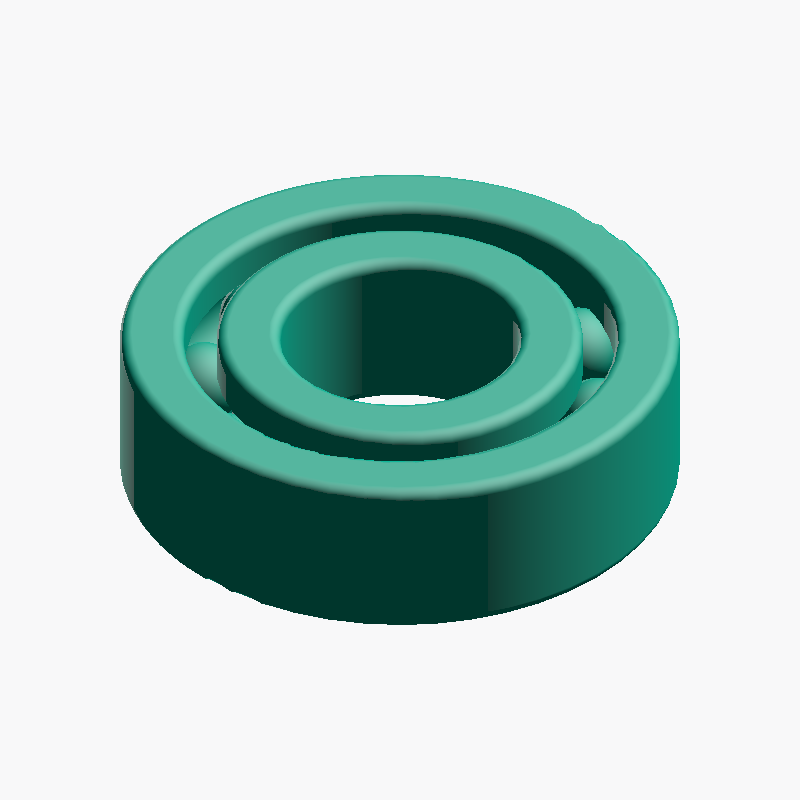
- ⚡ Calcolatore resistenza LED Calcola il valore della resistenza necessaria e la potenza dissipata dalla tensione di alimentazione, tensione diretta del LED e corrente
- 🧩 Calcolatore tolleranze di accoppiamento ISO (ISO 286) Calcola le tolleranze di foro e albero e il tipo di accoppiamento dal diametro nominale e dalla classe di tolleranza
- 📐 Calcolatore distanza tra centri pulegge GT2 Calcola la distanza tra i centri delle pulegge GT2 dalla lunghezza della cinghia